
Summary
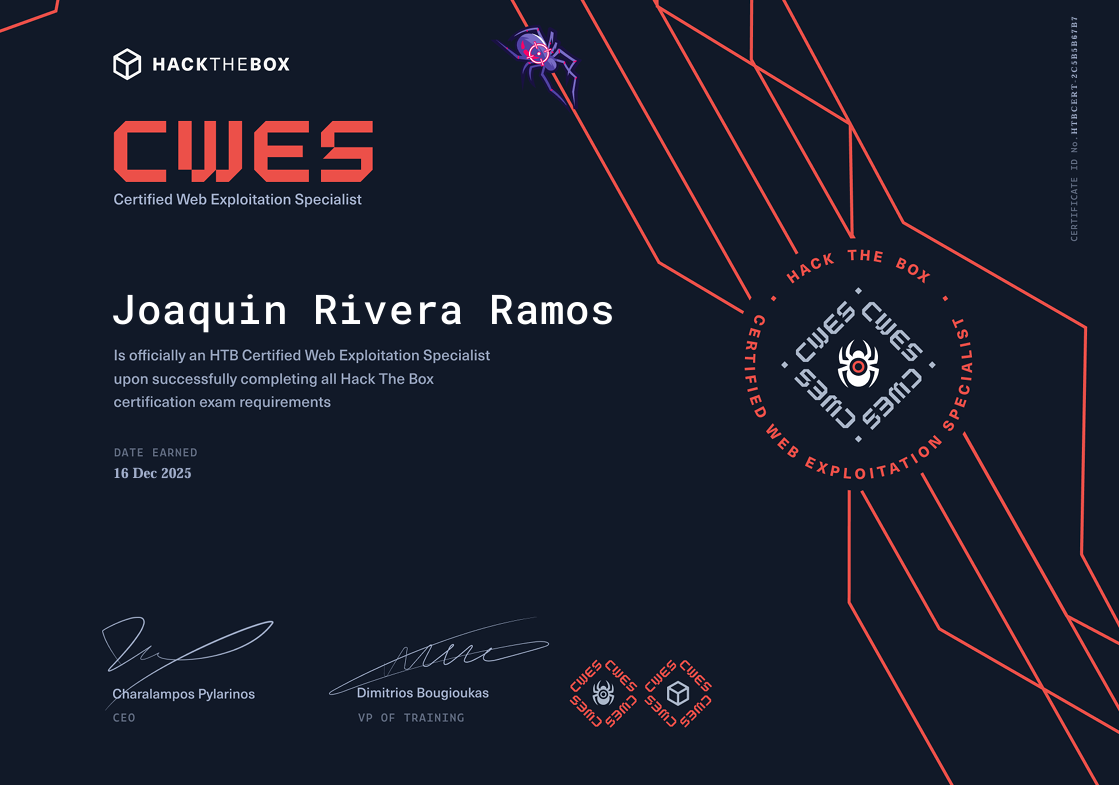
The CWES (Certified Web Exploitation Specialist) by Hack The Box is a certification focused on realistic web exploitation, methodology and technical skill applied to lab-style and exam environments.
In this post I want to share my personal experience: what I liked, what I didn’t, and whether it’s really worth it for someone who wants to improve at web.
What is the CWES?
The CWES is an exam entirely focused on web vulnerabilities, so don’t expect to root the whole machine like a traditional HTB box. First you have to get an initial foothold and, from there, escalate privileges until becoming Web Root within the application.
The exam lasts 7 days and, during that time, you also have to prepare and submit the final report. If you don’t send the report within that window, the exam is considered failed.
Before sitting the exam
Before sitting it, I had already earned certifications like eJPT, eCPPT and eWPTX. I consider the latter the closest one, but even so I wouldn’t put it at the level of the CWES.
It took me roughly 2 months to complete the Hack The Box study path and complement my preparation with PortSwigger and Vulnyx labs.
Content and syllabus
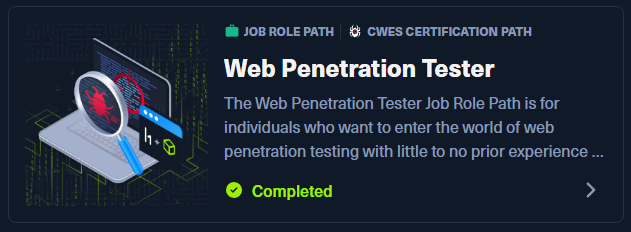
If we talk about the syllabus, my recommendation is to complete the entire path HTB offers, in this case the Web Penetration Tester one.
What helped me most
Honestly, the labs recommended by Jackie0x17 helped me a lot, many of which can be found on Vulnyx. Some of the ones that served me best were the following:
- Swamp
- Express
- Bola
- JarJar
- Gattaca
- Future
- Jerry
- Lost
What felt more tedious
What really felt heavy was taking notes on what I was studying. There were times when I already understood how certain vulnerabilities worked, but even so I was lazy about documenting each one.
Still, doing it ended up helping me a lot, because when reviewing everything was much more organized and it was easier to lock in concepts, remember attack vectors and arrive better prepared to the exam.
Real difficulty
My overall sense was the following:
- Technical difficulty:
Intermediate - Exam difficulty:
Intermediate - Advanced - Time management:
8 hours of exam + 2 hours of rest
My experience with the labs
- Good lab quality.
- Much of what you learn in the path is applied in a practical way.
- They help develop judgment so you don’t fall so easily into rabbit holes.
- There’s a good balance between theory and practice.
My experience with the exam
I managed to complete the entire exam in a total of 3 days and took 2 additional days to finish the report calmly. My organization was fairly methodical: first I built a checklist for each web application and validated which vulnerabilities were really exploitable and which weren’t, so as not to waste time on paths that added nothing.
In this exam, fuzzing well is absolutely key, because finding hidden files, routes and directories can make the difference later in the exploitation chain. I also found it very interesting that several parts required chaining vulnerabilities to get initial access or even Web Root privileges, since that makes it much more realistic and demanding at a methodological level.
In my case, the hardest part was flag number 8. It took me around 7 hours to fully understand the vulnerability and, in the end, it was something that had indeed been covered in the labs. Looking back, I think the real problem wasn’t technical but mental: the pressure and the fear of getting stuck can make you overcomplicate something that was actually within your reach.
My recommendation for anyone who wants to sit it is clear: bring a strict methodology from the start, document everything as you go and don’t underestimate enumeration. In a certification like this it doesn’t only matter to find the vulnerability, but to know how to prioritize, discard rabbit holes quickly and keep a cool head when a part of the exam starts consuming too much time.
The best of the CWES
- The certification has a very clear relationship with what you learn in the path, so you feel the study really contributes to the exam.
- The quality of the labs seemed good to me and, in general, they help a lot to develop web judgment.
- I liked that the focus was practical and oriented toward exploiting vulnerabilities methodically, not just memorizing theory.
The worst of the CWES
- Sometimes the labs went down, and that can really break your study rhythm.
- There are certain rabbit holes that make you lose time, especially if you’re not yet fluent at filtering what matters.
Who would I recommend it to?
I’d recommend it to:
- People who already have a base in web pentesting and want to make a leap toward a more demanding and practical environment.
- Folks who enjoy methodology, enumeration and chained exploitation of vulnerabilities.
I wouldn’t recommend it to:
- People just starting out in web security.
- Those who still rely too much on automated tools without really understanding what they’re doing.
Final verdict
For me, the CWES is a very solid certification if you really want to improve at web exploitation from a practical approach. I didn’t find it an exam for memorizing concepts, but for demonstrating methodology, judgment and analysis under pressure.
If you already have a previous base and are willing to dedicate serious time to the preparation, I think it’s a very good certification and an experience I would repeat.
Certificate